Pharmacological properties
ATCvet QP53, ectoparasiticides, insecticides and repellents (QP53BX, other ectoparasiticides for systemic use).
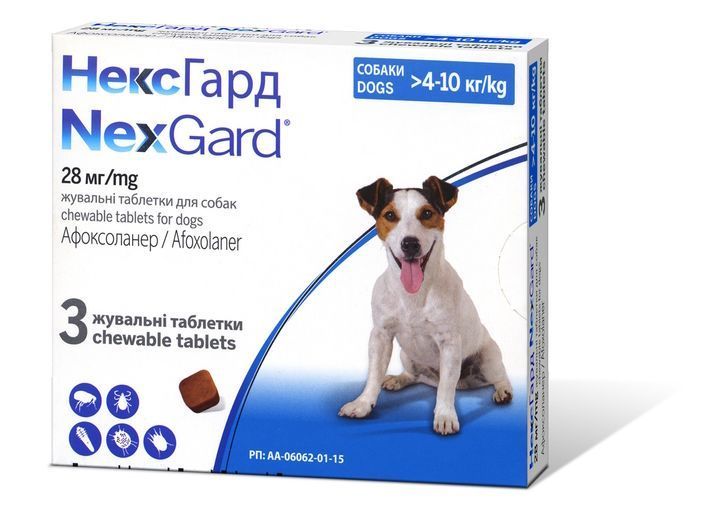
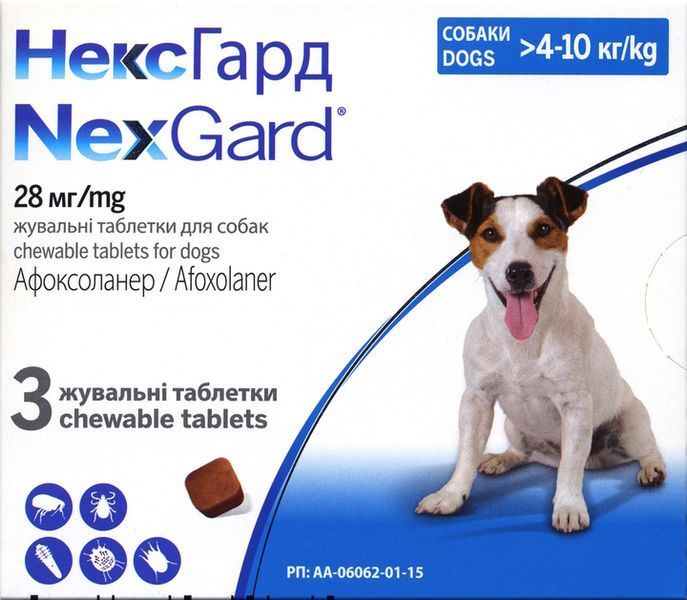
The product is an insecticidal and acaricidal agent in the form of chewable tablets used for prevention and treatment of dogs infected with ectoparasites, as well as for prevention of tick infestations.
Afoksolaner belongs to the isoxazoline class compounds; its action is based on blocking GABA-dependent receptors in parasites, disrupting nerve impulse transmission, leading to nervous system damage in ectoparasites and their death. This effect is characteristic only for invertebrates and is safe for mammals. The receptor binding differs from other commercial GABA-inhibiting insecticides, reducing the possibility of cross-resistance.
Afoksolaner is active against adult stages of fleas (Ctenocephalides felis and C. canis) and ticks (Dermacentor variabilis, D. reticulatus, Ixodes ricinus, I. scapularis, Rhipicephalus sanguineus, Amblyomma americanum, and Haemaphysalis longicornis). Afoksolaner kills fleas before they lay eggs.
The action of NexGard on ectoparasites starts within 4 hours after administration and reaches nearly 100% efficacy by 8 hours. The product prevents re-infestation by fleas and ticks for one month.
After oral administration in dogs, afoksolaner is rapidly absorbed and distributed in the animal's body.
Bioavailability of afoksolaner is 74%. Maximum plasma concentration of active substance is 1655±332 ng/ml, reached 2–4 hours after administration at a dose of 2.5 mg afoksolaner per 1 kg of body weight. The average plasma half-life in dogs is 2 weeks and depends on breed (e.g., in collies – 47.7 days). Afoksolaner is excreted with bile and urine.
Clinical particulars Animal species: Dogs.
Indications for use
Prevention and treatment of dogs infested with ticks (Dermacentor variabilis, D. reticulatus, Ixodes ricinus, I. scapularis, I. hexagonus, Rhipicephalus sanguineus, Amblyomma americanum, and Haemaphysalis longicornis) and fleas (Ctenocephalides felis and C. canis).
The product can be used as part of treatment for flea allergic dermatitis in dogs.
Treatment of demodicosis (caused by Demodex canis).
Treatment of sarcoptic mange (caused by Sarcoptes scabiei var. canis).
Treatment of otodectic mange (caused by Otodectes cynotis).
Contraindications
Do not use in sick, emaciated, or weakened animals!
Do not use in animals with known hypersensitivity to the components!
Side effects
Not observed.
Special warnings
Use in animals younger than 8 weeks and/or weighing less than 2 kg should be based on risk assessment.
Use during pregnancy and lactation
Safety in pregnant and lactating dogs has not been established. Use is determined by a veterinarian considering possible risks.
Interactions
Not established.
Dosage and administration
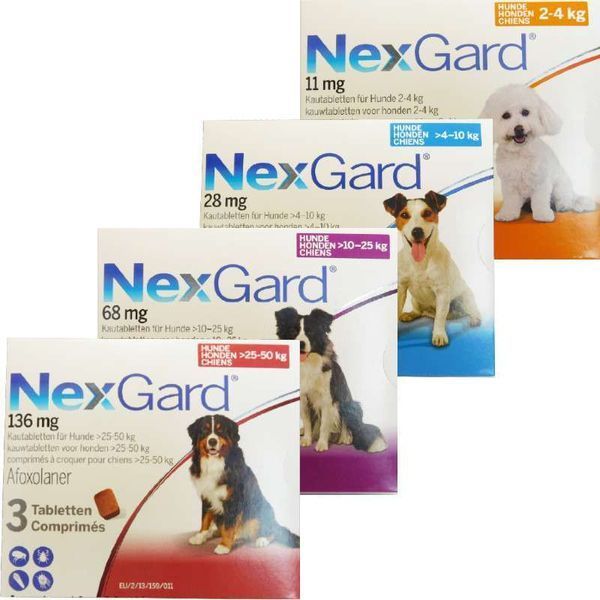
Administer orally with food or forcibly at dose 2.7–6.9 mg/kg body weight:
Body weight, kg
Dose, tablets
2–4
1 × NexGard 11 mg
4–10
1 × NexGard 28 mg
10–25
1 × NexGard 68 mg
25–50
1 × NexGard 136 mg
Dogs over 50 kg receive a combination of tablets.
Treatment against fleas and ticks is done once every 4 weeks.
Treatment of demodicosis – monthly until two negative skin scrapings are obtained.
Sarcoptic mange – once a month for 2 months.
Otodectic mange – single dose, repeat after one month if needed.
Overdose
No overdose symptoms observed even at 5 times the dose. Collies may show diarrhea or vomiting.
Precautions
Complete prevention of transmission of vector-borne diseases is not possible – the product acts after parasite bite.
Withdrawal period
Not established for non-productive animals.
Safety measures for humans
Work in gloves, maintain hygiene, keep away from children. Wash hands with soap after use.